




Dvar Torah- ויחי
Throughout Jewish texts, some of the Twelve Tribes seem to be more "major" players in history, while some seem to be "minor." As a test, I offer the following: name two people each from the tribes of (a) Benjamin (b)
In this week's parsha, Vayechi, Jacob blesses his sons before his death. To some, he blesses longer, more eloquent blessings; to most of the rest, the blessings are short and blunt. Zebulun, one of the "minor" tribes, receives the following:
זְבוּלֻן לְחוֹף יַמִּים יִשְׁכֹּן וְהוּא לְחוֹף אֳנִיּוֹת וְיַרְכָתוֹ עַל צִידֹן
"Zebulun shall dwell at the haven of the sea; and he shall be for an haven of ships; and his border shall be unto Zidon" (Gen 49:13)
What is this about? Whereas some of the brothers get blessings of leadership or prosperity or strength, Zebulun is blessed with... a portion in the
Furthermore, the Talmud (Megillah 6a) suggests a conflict in the actual distribution of the land that differs with Jacob's promise of ports: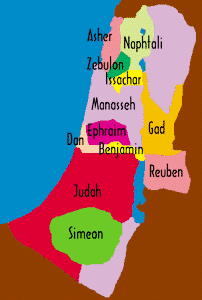
והא קטרון בחלקו של זבולון הואי, דכתיב (שופטים א') זבולון לא הוריש את יושבי קטרון ואת יושבי נהלל. וזבולון מתרעם על מדותיו הוה, שנאמר (שופטים ה') זבלון עם חרף נפשו למות, מה טעם - משום דנפתלי על מרומי שדה. אמר זבולון לפני הקדוש ברוך הוא: רבונו של עולם! לאחיי נתת להם שדות וכרמים ולי נתת הרים וגבעות, לאחיי נתת להם ארצות - ולי נתת ימים ונהרות
The gist of this is that Zebulun complains to God that whereas his brothers received fields and vineyards, he received mountains and hills; the brothers received lands, while he received oceans and rivers. (Note: the part about the hills rings true with most interpretations of the division of Israel, which places Zebulun in the hilly Lower Galilee-- right around the area of Ma'aleh Gilboa. I also don't see any seaports...)
Furthermore, not much more is written about Zebulun in the rest of Jewish texts. Most of the time he appears, it is with his brothers in a census or division of the land or military conquest. The only famous person I could find from the tribe is Elon the Zebulunite (Judges
I realized, however, that a lack of mention does not make Zebulun any less of a tribe, any less God-fearing, any less significant. Perhaps Zebulun's importance is more behind-the-scenes, a job whose significance is appreciated mostly by those who depend on them. All the actors out there know what I mean: if that light cue doesn't go, if that prop isn't there, if that sound clip is late, you look stupid and feel lost.
This is Zebulun's role for the Jewish people. Zebulun is a financial provider, one who deals in trade and business. And, as Jacob blesses, there is nothing wrong with that; on the contrary, business can be for a very good end. At the end of the Torah, Moses blesses the tribes before his death, and says to Zebulun:
וְלִזְבוּלֻן אָמַר שְׂמַח זְבוּלֻן בְּצֵאתֶךָ וְיִשָּׂשכָר בְּאֹהָלֶיךָ
עַמִּים הַר יִקְרָאוּ שָׁם יִזְבְּחוּ זִבְחֵי צֶדֶק כִּי שֶׁפַע יַמִּים יִינָקוּ וּשְׂפוּנֵי טְמוּנֵי חוֹל
"Of Zebulun he said, "Rejoice, Zebulun, in your going out; and Issachar, in your tents.They will send out the word for the people to come to the mountain, taking there the offerings of righteousness: for the store of the seas will be theirs, and the secret wealth of the sand. " (Deut. 33:18-19)
The Talmud cited above (Megillah 6a) addresses Zebulun's complaint by interpreting Moses' blessing:
. אמר לו: כולן צריכין לך על ידי חלזון, שנאמר (דברים ל"ג) [עמים הר יקראו]... ושפני טמוני חול. תני רב יוסף: שפני - זה חלזון, טמוני - זו טרית, חול - זו זכוכית לבנה
God responds by saying that Zebulun's sea-faring ways are not only essential to the national economy, but also for other holy devices: the שְׂפוּנֵי hint to the chilazon, a sea-creature from which the blue dye for the tzitzit is made; the טְמוּנֵי hints to the fish (sages interpret this as either tuna or sardine) that will become a seafood staple of the people; and the חוֹל means white glass, which apparently is very pretty, decorative, and expensive.
In some ways, the financial support Zebulun provides is more important than Torah. In Pirkei Avot, the sages teach that "without flour [sustenance], there is no Torah" (3:21). This statement is manifested in Jacob's blessing. Jacob began by blessing Leah's sons, starting with the eldest Reuben and then proceeding in order to Simeon, Levi, and Judah. Issachar should be next, followed by Zebulun to conclude Leah's six sons. But Jacob places Zebulun before Issachar. Rashi comments by saying that Zevulun comes first because without financial support, Issachar could not exist, as Issachar is the tribe that toils in Torah constantly.
The point of all this? Serving God can be done in business as well. Supporting Torah is as valuable as Torah itself. And the fact that this year we yeshiva students are Issachar, next year we will be in the army or university. But even though we will be in environments that will not foster constant Torah study, let us not forget that our contibutions to society are nonetheless valuable. Hopefully, each of us will be able to find an appropriate balance between the values of Zebulun and Issachar, the symbiotic brothers.
Shabbat Shalom.
posted by Yoni Bain | 2:04 AM

1 Comments:
This comment has been removed by a blog administrator.
Post a Comment
<< Home